The Best Claw Clip Shape for Thick Hair: A Fit Guide
Use your actual twist to choose between deep, wide, and open-shape claw clips, with two Kitsch jumbo designs as examples.
In this guide
The first time a claw clip lets a twist unravel is usually when you are doing something else with both hands. You put your hair up before cooking, turn to check a pan, and feel the ends fall out. The next clip you buy does not necessarily need a stronger spring. It needs to close around the amount of hair you put in it, with its teeth positioned so they can hold the twist instead of resting on its outside. Those are different requirements.
Thick hair can mean a large number of fine strands, fewer strands with a coarse texture, or long hair that doubles over when you make a twist. All three can produce a large bundle, but they do not fit the same shape. Think about how you actually gather your hair, where you want the clip to sit, and whether you will lean against a headrest with it on. You can solve most fit problems by comparing those three details before you shop.
Measure the style, not the circumference of your ponytail
Start with the style you need on a typical day. Make a loose vertical twist as you normally would and hold it at the point where you want the clip. If the ends hang down past the base of the twist, decide whether you like them loose or want to tuck them in. Tucking creates a second layer in exactly the area the clip needs to hold. A clip that can secure a long hanging twist might struggle once the same length is doubled up.
Notice whether the part of the twist you are holding is narrow and tall, or broad and low. A deeper shape can cover more of the narrow bundle without pressing it flat. A longer row of teeth can help distribute contact along a broad style. You do not need to record a perfect measurement. Hold the twist beside a clip you own and notice where the hinge and teeth land. If the teeth barely touch when you close it, focus on the opening and depth. If the teeth meet but hair slips out the bottom, focus on the placement and the length of the row.
For textured hair, make the twist the way you would actually wear it. Smoothing it tighter than usual to make a clip fit changes the question. A clip that only holds after you compress the style may be fine for a short chore, yet uncomfortable when you wear it for an afternoon. If a full twist feels too large with every shape you try, start with a half-up style or let more of the ends hang free.
Read dimensions in the right direction
Jumbo is a category name. Brands can use it for a long, narrow clip or one with a deep cavity between the teeth. A length listed along the hinge does not describe how far the teeth open. A large side profile in a product photo does not tell you whether the underside has space for a doubled-over twist. Look for photographs from the side and below. Use images of an open clip when the listing includes them. Read the manufacturer’s dimensions with the axis in mind, and resist converting an overall length into a claim about jaw capacity.
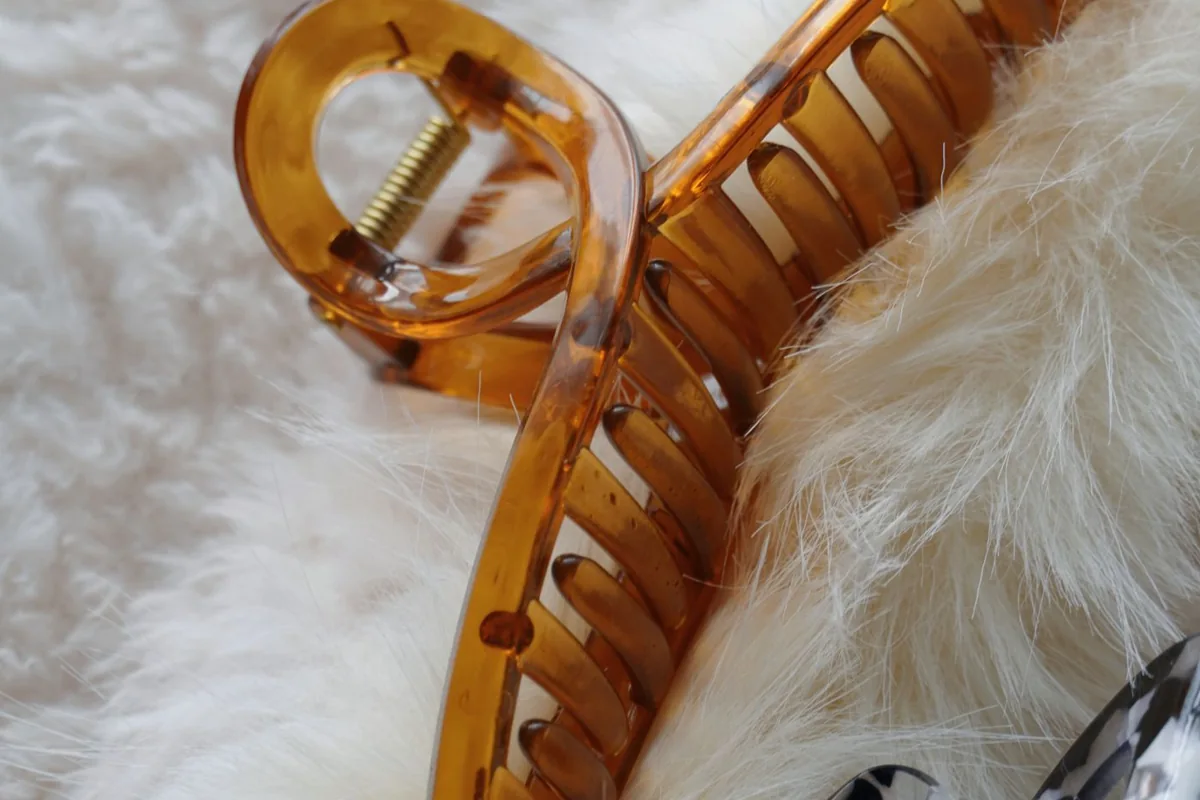
Kitsch’s Black & Tort Classic Claw Clips 2pc Set shows what the brand means by a classic jumbo claw. It is a useful reference for comparing the teeth and hinge shape with a clip you know. Its Black Marble Jumbo Claw Clip uses an open outline. That makes the shell look and sit differently, but the opening in the back is a design detail. You still need to check whether the teeth come around your bundle at the point where you want them. Neither style name establishes what it will hold on your head.
| What happens to your current clip | What to compare first |
|---|---|
| The teeth hang open and the twist pushes outward | More interior depth, less hair doubled back, or a clip that opens wider |
| The upper part holds but the base slips | A longer tooth row or a lower starting position |
| Hair gets pinched near the hinge | A different tooth and hinge layout, or a smaller section |
| The style holds until you sit against a headrest | A lower-profile style or a different way to secure the twist for travel |
| You can wear it only by twisting tighter | A deeper opening or a half-up style that uses less hair |
Pick a spring you can actually use
There is a difference between a spring that feels reassuring when you open it and one that is comfortable to operate while holding your hair above your shoulders. If you regularly put your hair up using one hand to hold the twist and the other to open the clip, check the lever surfaces. A broad place to press can be easier to use than narrow, smooth tips. If you need both hands just to open the clip fully, you may end up dropping the twist while repositioning it.
When you can handle a display clip, open it once with dry hands and observe how far the jaws spread before the squeeze becomes awkward. Open it again with the hand you usually use. Then see whether the teeth meet cleanly when you let go. A clip that looks symmetrical in a listing may close differently when you press near the edge. Avoid forcing a spring past the range that feels natural. For online shopping, look for images of fingers operating the levers and read the return conditions for the exact seller. Fit is easier to judge in person than from a model’s hairstyle.
Weight is another practical consideration. A larger clip can feel fine for an hour at your desk yet pull more when you walk, climb stairs or wear it over several layers of hair. An open design can reduce the amount of visible shell, but its comfort still depends on where the teeth and hinge sit. If the clip is going in a work bag every day, check whether the outer shape catches on a pouch lining or other objects. A piece you only enjoy wearing at home need not become your all-purpose choice.
Test movement where it matters
A useful fit check takes three minutes. Put the hair up without rushing. Look for sections visibly trapped near the hinge, and reposition it if it pinches. Turn your head to both sides, lean forward briefly, then walk around the room. If the twist falls toward one side, check where you placed it. A small position change may balance the weight before you decide the clip is too small.
Then repeat the activity that made your old clip frustrating. Sit in a chair with a tall back if you wear it while working, or pull a sweater on if that is when you usually knock it out. When a clip pushes against a car headrest, remove it or switch to a lower-profile style before driving. Do not count static hold at a mirror as proof that it will fit everywhere. Two clips in different sizes can serve different purposes, but you do not need a collection if moving one clip lower solves the daily problem.
Buy a deeper jumbo if your regular twist leaves the jaws open and you can hold the bundle comfortably without tightening it. Choose a longer design if the main issue is hair sliding below the teeth. Keep your existing clip if it secures a slightly different twist without pulling. The useful upgrade is the one that gets your hair out of the way while you do something else, which is the reason you put it up in the first place.